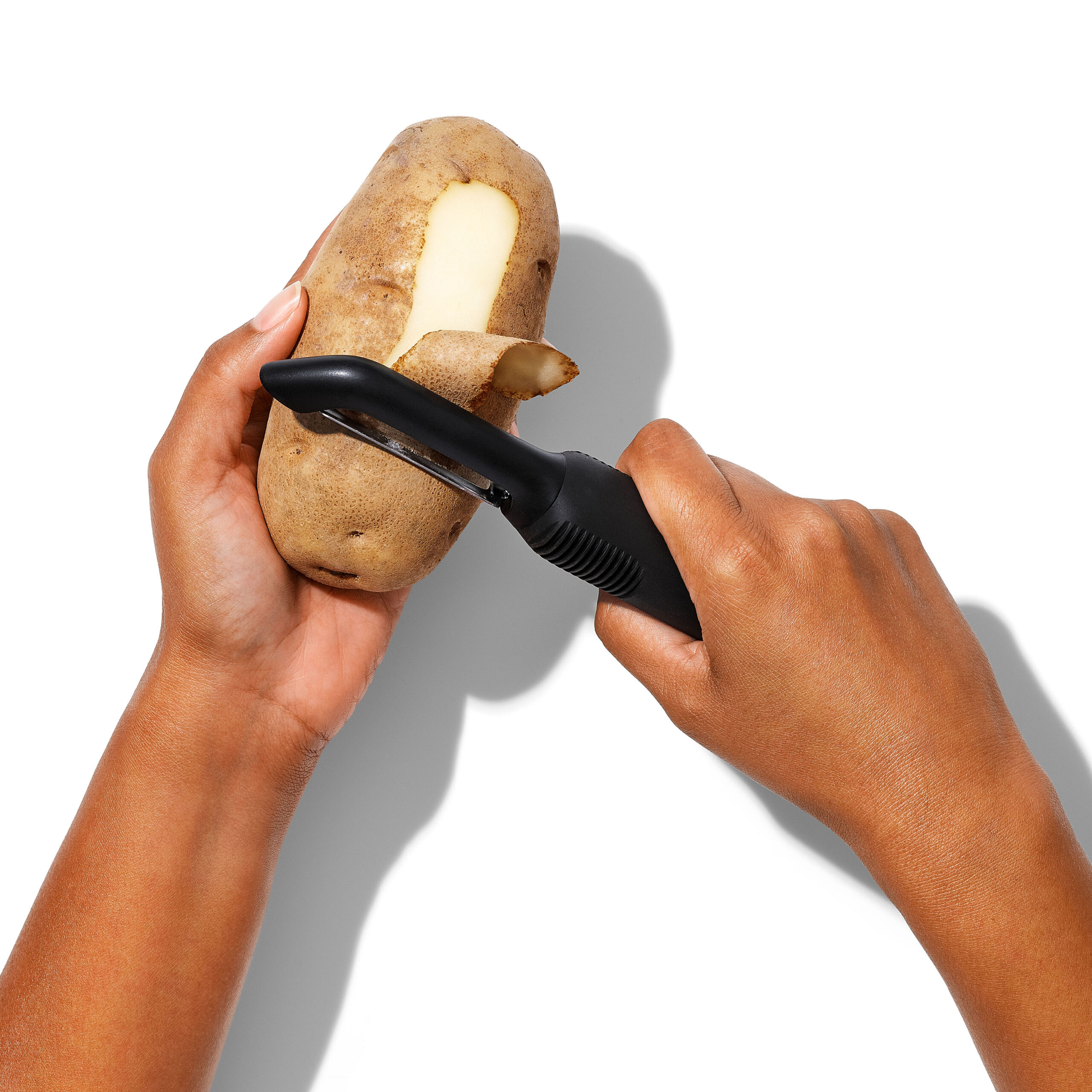
Before an object belongs to a room, it has to belong to a moment of use. A hand closes around it. Someone lifts it, adjusts it or puts it down. That encounter can be easy to overlook in a photograph.
A handle is a good place to start.
A change in the grip
OXO traces the beginning of Good Grips to Betsey Farber’s difficulty using a peeler with arthritic hands. The response included a wider, oval handle and a soft, non-slip material. Flexible fins encouraged people to touch it.
Source: OXO, Behind the Design: Good Grips Handles ↗The handle makes a point about where design attention can go. The object’s appearance and the experience of holding it are connected. A detail can make something more inviting before a person has read a word about how it works.
Look closer: view the Butterfly Stool in Vitra’s archive ↗
A curve doing its work
Sori Yanagi’s Butterfly Stool, dated 1956 by Vitra, joins two curved plywood shells. Vitra describes its meeting of Eastern forms and the plywood-moulding technique developed by Charles and Ray Eames.
Source: Vitra, Butterfly Stool ↗Its silhouette is expressive, but it also makes its construction visible. Looking at it becomes a way of wondering how it holds together.
These objects answer different needs. They leave a shared question: how much attention are we willing to give the part of a design that someone actually encounters?
That question extends to objects made to offer support. Their users have tastes, homes and public lives as well as practical needs. There is room to ask for usefulness and an appearance someone wants to live with. Neither tells us, on its own, whether an object will suit a particular person.
For now, try looking at a familiar object from the point of contact. The curve under a thumb. The edge against a wrist. The part a product photograph almost crops out.